The ELECTRIC UNIVERSE® model has made some capital from the fact that the key evidence for a nuclear engine in the Sun, the neutrino count, failed to live up to expectations. In Physics World, July 2001, [see http://physicsweb.org/article/world/14/7/10 ] an article appeared that asserted that the solar neutrino puzzle is now solved and that it “confirms that our understanding of the Sun is correct.” Is this a serious blow to the ELECTRIC UNIVERSE® model? The short answer is no! The longer answer requires a bit of background.
Why does the Standard Solar model have a neutrino puzzle?
The Sun is mostly hydrogen gas. According to the Standard Solar model, if the Sun were not generating heat, gravity would compress all of the gas into a much smaller space. Since the sun is bigger than a hydrogen sphere held together by gravity, we know (along with the fact that it shines VERY brightly) that there must be a source of energy inside. And only nuclear energy can produce enough energy to last for billions of years. According to the Standard Solar model, originally proposed by Eddington* in the 1920’s, just knowing the solar radius and mass and that the sun is supported in hydrostatic equilibrium we can calculate the temperature in the center needed to support the rest of the sun. The temperature works out to be of the order of 10 to 20 million degrees Kelvin.
What is the nuclear process that is supposed to maintain this unimaginable temperature?
At tens of millions of degrees hydrogen is fully ionized into electrons and protons and the resulting energetic protons are free to collide. It is proposed that such collisions form the first step in a chain of nuclear reactions known as the proton-proton (p-p) chain. In the p-p reaction, two protons are fused together to form a deuteron, a positron and a neutrino. A deuteron consists of a proton and neutron. A positron is a positively charged electron. For this reaction to happen the two colliding protons must approach each other within 0.1 trillionth of a centimetre and simultaneously one of the protons must decay to a neutron and positron. Although it is extremely improbable for this reaction to happen (one reaction per particle in 14 thousand million years!), there is such a vast supply of protons available that it is argued many such reactions occur. The second stage in the p-p chain is the fusion of a deuteron with another proton to form a nucleus of an isotope of helium, 3 He, consisting of two protons and one neutron, and a gamma ray photon. In the last stage this isotope must fuse with another 3 He isotope to form a helium nucleus, 4 He, and two protons. The first two steps must occur twice before the last can take place.
Producing nuclear fusion by squeezing and heating matter is the most inefficient method conceivable, as witness the half-century long attempts to produce fusion power. It is highly improbable even under the calculated extreme conditions at the center of the Sun. The unlikely process above omits to mention that quantum tunnelling is also needed to make it work. And if nuclear fusion is happening as theorized, it can only produce the first few light elements in the periodic table. Where do the heavy elements, seen in the Sun’s spectrum, come from? Don’t say “from supernovae” because there are far too few of them. What’s more, they are in the business of dispersing matter into the vastness of interstellar space. Wouldn’t it be better to have a theory that solved this fundamental problem in situ for all stars? Nature does not do anything the hard way so why would she not use the same technique that particle physicists use to create heavy elements on Earth – particle accelerators? But particle accelerators require electrical power and astrophysics is the only science that does not use it! Astronomy remains, with Eddington, in the gas-light era.
The Neutrino Problem
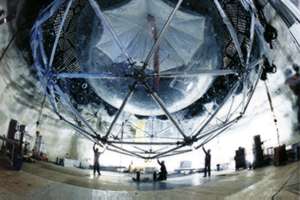
From the usual understanding of the p-p reaction, about 1.8 x 10^38 neutrinos are produced by the Sun per second. That means at Earth’s distance, some 400 trillion neutrinos go through our bodies every second! This is a phenomenal number, and yet there is not the slightest interaction with any of them. However, detection of these neutrinos would give us a method to “view” inside the solar core because they pass through the substance of the Sun with ease. On the other hand, radiant energy from the Sun’s core may take millions of years to percolate to the surface. The problem is to detect the neutrinos, since those from the p-p reaction have an energy which is far too low for detection. However, higher energy neutrinos are known to come from a side reaction involving 3 He and 4 He particles to form a beryllium nucleus (7 Be) which then captures a proton to form a boron nucleus (8 B); this nucleus then breaks up into Beryllium (8 Be) plus a positron and neutrino. Only 2 of these reactions are produced out of 10,000 completions of the p-p reaction, so these neutrinos are rarer. To detect these higher energy electron neutrinos, a large vessel (400 cubic metres) filled with dry-cleaning solvent (perchloroethylene) was placed 1.5 km underground in a gold mine in South Dakota — away from all other cosmic radiation. Left for 3 months a few of the chlorine atoms ( 37 Cl) are expected to react with the neutrinos to form 37 Ar and an electron, which then reverts to 37 Cl plus a neutrino. The 37 Ar atoms are purged with helium gas and the decay is counted. According to the standard model, the detector should measure about 8 x 10^-36 interactions per second per atom or 8 SNU (pronounced ‘snoo’) with an error rate of 33%. The neutrino detector has averaged only 2.2 SNU with a deviation of 0.3 SNU. The detection has been only about one third of the calculated number and the discrepancy is well outside both the uncertainty of the calculations and experimental deviations. The problem was so intractable for the Standard Solar model that the particle physicists were called upon to determine if there was something we did not know about the neutrino. They proposed that if neutrinos had mass (so far undetected) then they might oscillate between the three known forms, the electron, muon and tau neutrino. The low count of electron neutrinos might then be accounted for if they had changed “flavour” on their journey from the Sun’s core to the Earth.
Solar neutrino puzzle is solved
The Physics World article opened confidently with the above heading and the assertion, “New evidence that solar neutrinos can change ‘flavour’ confirms that our understanding of the Sun is correct and that neutrinos have mass.” It continued:
“The first results from the Sudbury Neutrino Observatory [SNO] in Canada have finally solved a problem that has puzzled astrophysicists for 30 years: why do experiments detect less than half the number of solar neutrinos predicted by models of the Sun? The results confirm that electron neutrinos produced by nuclear reactions inside the Sun ‘oscillate’ or change flavour on their journey to Earth. Neutrino oscillations are only possible if the three flavours of neutrino [electron, muon and tau] have mass. The SNO result therefore has important implications for cosmology and particle physics.
The Sudbury Neutrino (SNO) experiment
Although the SuperKamiokande experiment in Japan has seen strong evidence for the disappearance of “atmospheric neutrinos” [neutrinos that are produced when cosmic rays interact with nuclei in the Earth’s atmosphere (Physics World July 1998 pp17-18)] the SNO results are significant because, when combined with solar-neutrino data from SuperKamiokande, they show for the first time that the disappearance of one neutrino flavour is accompanied by the appearance of another. This is the key signature of neutrino oscillations. The new results are also in excellent agreement with the predictions of standard solar models.
The SNO collaboration includes physicists from 15 centres in Canada, the US and the UK, and the results were presented on 18 June at the annual conference of the Canadian Association of Physicists in Victoria, and at seminars at Oxford University in the UK and the University of Pennsylvania in the US. They have also been submitted to the journal Physical Review Letters. “It is incredibly exciting to see such intriguing results coming out of our first data analysis,” says the collaboration’s UK spokesman, David Wark of the Rutherford Appleton Laboratory and Sussex University, “and there is so much more to come.”
Neutrinos are elementary particles of matter with no electric charge and very little mass. They only interact weakly with matter, which makes them very difficult to detect. Indeed, the SNO experiment detects a mere 10 or so solar neutrinos per day. Electron neutrinos are produced in the Sun’s core when boron-8 nuclei undergo beta decay: the Sun is not thought to produce muon or tau neutrinos. Previous experiments have detected less than half of the predicted solar-neutrino flux, but these experiments were only sensitive to electron neutrinos. The combined SNO and SuperKamiokande results make it clear that this shortfall arises because electron neutrinos have changed into muon or tau neutrinos.
‘This result agrees perfectly with theoretical predictions and indicates that we really do understand the nuclear processes that are the source of the Sun’s energy’, says Lincoln Wolfenstein, a particle theorist at Carnegie Mellon University in the US. According to the SNO detector, the flux of electron neutrinos from the Sun is 1.75 million neutrinos per square centimetre per second. The SuperKamiokande experiment puts the total flux at 2.32 million in the same units (S Fukuda et al. 2001 Phys. Rev. Lett. 86 5651, 5656). By comparing these figures, physicists from SNO and SuperKamiokande calculated that the true solar-neutrino flux is 5.44 million neutrinos per square centimetre per second, which is in excellent agreement with the ‘standard solar model’ of energy production in the Sun.”
The headline underscores a cultural problem in reporting science that leads to bald statements of “fact” when a conclusion is in fact conjectural. The detection of neutrino oscillations cannot confirm the Standard Solar model. It merely offers a possible solution to one of a number of serious observational problems with the Standard Solar model. There can be no confirmation of oscillation of neutrino flavours between the Sun and the Earth without simultaneous neutrino measurements being made near the Sun. And that poses formidable experimental problems. On the other hand, the ELECTRIC UNIVERSE® proposes an electrical model for stars, based on the pioneering work of Ralph Juergens. It argues that Eddington’s model, which treated the Sun as a ball of neutral gas, is wrong. The large difference in the weight of the proton, 1836 times heavier than the electron, ensures that in the Sun’s strong gravity hydrogen atoms will form weak electric dipoles with their positive poles aimed at the Sun’s center. (At temperatures near that of the Sun’s surface, hydrogen is only weakly ionized). And since the electric force outguns gravity to the tune of 39 powers of 10, its omission from the Standard Solar model renders that simple gas model unrealistic. The effect of the radially aligned atomic dipoles is to propel free electrons in the plasma toward the Sun’s surface, leaving behind an excess of positive charge. As we know, like charges repel, so the interior of the Sun will simply resist compression due to gravity. In other words, the electric force will tend to compensate for gravitational compression and make the Sun more homogeneous, with presumably a small core. In fact, the Sun is about the size expected if its hydrogen were not compressed by gravity! So it is not necessary for an internal nuclear furnace to bloat the Sun to the size we see.
It is important to stress that the only other method of divining what is inside the Sun, that of measuring small solar surface oscillations, or helioseismology, supports a homogeneous model of the Sun. In 1976 the discoverers of a dominant 160 minute radial pulsation of the Sun were well aware of that serious implication of their discovery. The Sun can have no nuclear engine! Everything possible has been done since to explain the observation away, without success. It remains one of those damned facts that will be explained… someday soon. Meanwhile, most of the complex oscillation overtones have been fitted to Standard Solar models. But that is not surprising given the many degrees of freedom to tweak those mathematical models. The Electric Sun hypothesis has the virtue that it does not require any hidden activity inside the Sun to explain the features of the Sun. It is amenable to physical testing in the laboratory because we are not dealing with supposed unearthly conditions at the center of a star and because plasma phenomena are scalable over 14 orders of magnitude (at last count).
What if the neutrino discovery is correct?
It says nothing about the correctness of the Standard Solar model. However, it does have “important implications for cosmology and particle physics”. If neutrinos do have mass it will tend to confirm the ELECTRIC UNIVERSE® model. In it, neutrinos are not fundamental particles but are comprised of the same charged sub-particles that make up all matter. They are the most collapsed form of matter known. When a positron and an electron “annihilate”, the orbital energy in both is radiated as a gamma ray and the sub-particles that comprised them both assume a new stable orbital configuration of very low energy, or mass. Matter cannot be created from a vacuum nor annihilated in this model. The differences between the neutrino “flavours” is merely one of different quantum states and therefore different masses.
The electric Sun model expects far more complex heavy element synthesis to take place in the natural particle accelerators in the photospheric lightning discharges. In that case the various neutrino “flavours” are all generated on the Sun and do not need to “oscillate” on their way to the Earth to make up an imagined deficit. What is more, fluctuations in neutrino counts are expected in this model to be correlated with electrical input to the Sun, that is, with sunspot numbers and solar wind activity. This has been observed. The standard solar model does not expect any correlation since there is a lag estimated in the millions of years between the nuclear reaction in the core and its final expression at the surface of the Sun.
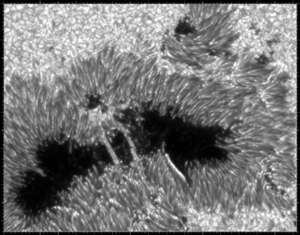
Electric discharges in plasma take the form of twisted filaments, seen here in a closeup of sunspots. Each filament is a powerful natural particle accelerator.
There is an experiment suggested by the SNO results that could confirm the Electric Sun’s photospheric origin of neutrinos. It would require continuous measurement of neutrinos of all flavours as a very large sunspot group rotated with the Sun. In this model, sunspot umbrae are not a source of neutrinos so there should be modulation effects associated with the Sun’s rotation that might be measurable with present equipment. Such an experiment, if sensitive enough, offers the possibility of detecting neutrino oscillations in the Sun as they traverse varying proportions of the body of the Sun. A positive result would falsify the standard nuclear model of the Sun.
The PhysicsWeb article continues:
“Proponents of ‘dark matter’ will be pleased to hear that neutrinos have mass. Astrophysicists have struggled for years to understand why galaxies rotate as if they contain more matter than we can see, and many believe this can only be explained by ‘dark matter’ that cannot be seen. ‘Our calculations show that neutrinos account for between 0.1% and 18% of the mass in the universe,’ says Wark. ‘Neutrinos may not account for all the dark matter, but they could certainly represent some of it now that we know they have mass.’ The new results limit the possible range of masses for neutrinos to between 0.05 and 0.18 eV.”
Comment:
A sea of neutrinos won’t account for galactic rotation curves — the neutrinos cannot be distributed evenly, but must be collected in a halo. Dark matter is not required to explain galactic form and rotation in a plasma universe. The galactic forms and evolution have been experimentally confirmed in plasma laboratories and in super-computer plasma simulations. No strange invisible matter is needed. However, a vast sea of unreactive neutrinos could be the long debated “ether” that permeates space. Space is not a void. We then have an electrically responsive medium for the transmission of light in which the characteristic velocity of an electrical disturbance in that medium is the so-called speed of light, c.
The PhysicsWeb article concludes:
Removing uncertainties. The new-found mass of neutrinos must also be incorporated into the Standard Model of particle physics. According to Wark, the neutrino could be the first ever example of a Majorana particle, a type of particle that is its own antiparticle. “If you could place a bet at the bookmakers on the next change to the Standard Model, the Majorana theory would be the front-runner,” he says.
Author: Katie Pennicott is Editor of PhysicsWeb
Comment:
In the ELECTRIC UNIVERSE® model, there is no antimatter forming antiparticles. An electron and a positron are composed of the same charged sub-particles in different conformations. They come together to form a stable neutrino, emitting most of their orbital energies in the process. They do not annihilate each other. In that sense a neutrino embodies both the electron and the positron. It can have no antiparticle. The bookmakers would be wise not to bet on the Standard Model of particle physics.
To sum up, the electrical model of the Sun requires that neutrinos of all “flavours” are produced by heavy element nucleosynthesis in the photosphere of the Sun. It is far simpler than the nuclear fusion model whose major assumptions cannot be confirmed, either by visual inspection or certain “rogue” data. All of the obvious electrical discharge phenomena seen on and above the photosphere have analogs that can be seen on Earth and/or reproduced in electrical engineering laboratories. It is simpler to assume that the energy we receive from the Sun is coming from where we see it – at the surface, or photosphere, rather than a minuscule and unlikely hydrogen bomb 93 million miles distant, shrouded in opaque gas. Then the fact that sunspots are dark makes perfect sense – it is cooler everywhere beneath the photosphere. Mysteriously generated magnetic fields are not required to explain every strange solar phenomenon and to defy the laws of physics in the process by breaking and ‘reconnecting’ hypothetical field lines. The surprisingly even magnetic field of the Sun, from the equator to the poles, is to be expected if the Sun is the focus of a cosmic electric discharge, as Juergens suggested 30 years ago. Magnetism cannot exist on the Sun without electric currents. Finally, the very experiments designed to confirm the Standard Solar model may instead confirm the Electric Sun model if neutrino variability can be clearly tied to sunspot activity.
A number of authors have suggested that we have almost reached the end of new science. That is true while we are confronted, in this scientific age, with a medieval response to a new paradigm. It is as if we were whisked back to the time of Copernicus and Kepler. Before that there was religious adherence to a complex Earth-centered Ptolemaic model of the heavens. It offered as its greatest virtue mathematical beauty in the addition of endless epicycles to make the model fit the observations of the heavens. The mathematicians were in their heaven and resisted the simpler but less beautiful (non-circular) Sun centered model. It required a revolution in thinking. Centuries later, the mathematicians are doing it again while they dominate astrophysics. It is very unwelcome for them to be confronted with a far simpler electrical engineer’s model of the Sun that does not require endless mathematical intervention to save it. Perhaps it remains for those without such a cloistered view to see that just as our civilization and science depends upon remotely generated electric power, the idea of a remotely powered electrical Sun has a certain uncommon-sense symmetry to it – particularly when plasma physicists have already identified the cosmic “transmission lines”.