holoscience.com | The ELECTRIC UNIVERSE®
A sound cosmology for the 21st century
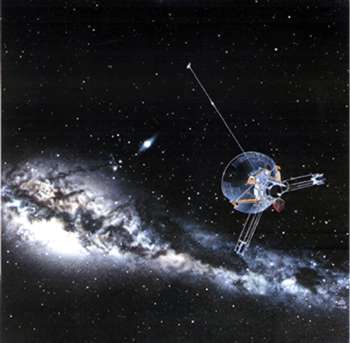
A Mystery Solved – Welcome to the ELECTRIC UNIVERSE®!
“We simply do not have a truly unified view of the world, one that paints an unambiguous picture of some overall scheme. …one invariably confronts a deep fissure that can be overcome only with revolutionary new ideas.”
– Etienne Klein & Marc Lachièze-Rey, THE QUEST FOR UNITY – The Adventure of Physics.
NASA has confirmed a “deep fissure” in our understanding of the universe. The answer, though revolutionary, is simple. But it implies that the real nature of the universe is nothing like the fanciful stories we are being told. So who will have the courage to listen? Robert Matthews, Science Correspondent for The Sunday Telegraph filed this report:
Mysterious force holds back NASA probe in deep space
A SPACE probe launched 30 years ago has come under the influence of a force that has baffled scientists and could rewrite the laws of physics.
Researchers say Pioneer 10, which took the first close-up pictures of Jupiter before leaving our solar system in 1983, is being pulled back to the sun by an unknown force. The effect shows no sign of getting weaker as the spacecraft travels deeper into space, and scientists are considering the possibility that the probe has revealed a new force of nature. Dr Philip Laing, a member of the research team tracking the craft, said: “We have examined every mechanism and theory we can think of and so far nothing works.” “If the effect is real, it will have a big impact on cosmology and spacecraft navigation,” said Dr Laing, of the Aerospace Corporation of California.
Pioneer 10 was launched by NASA on March 2 1972, and with Pioneer 11, its twin, revolutionised astronomy with detailed images of Jupiter and Saturn. In June 1983, Pioneer 10 passed Pluto, the most distant planet in our solar system. Both probes are now travelling at 27,000mph towards stars that they will encounter several million years from now. Scientists are continuing to monitor signals from Pioneer 10, which is more than seven billion miles from Earth.
Research to be published shortly in The Physical Review, a leading physics journal, will show that the speed of the two probes is being changed by about 6 mph per century – a barely-perceptible effect about 10 billion times weaker than gravity. Scientists initially suspected that gas escaping from tiny rocket motors aboard the probes, or heat leaking from their nuclear power plants might be responsible. Both have now been ruled out. The team says no current theories explain why the force stays constant: all the most plausible forces, from gravity to the effect of solar radiation, decrease rapidly with distance.
The bizarre behaviour has also eliminated the possibility that the two probes are being affected by the gravitational pull of unknown planets beyond the solar system. Assertions by some scientists that the force is due to a quirk in the Pioneer probes have also been discounted by the discovery that the effect seems to be affecting Galileo and Ulysses, two other space probes still in the solar system. Data from these two probes suggests the force is of the same strength as that found for the Pioneers.
Dr Duncan Steel, a space scientist at Salford University, says even such a weak force could have huge effects on a cosmic scale. “It might alter the number of comets that come towards us over millions of years, which would have consequences for life on Earth. It also raises the question of whether we know enough about the law of gravity.”
Until 1988, Pioneer 10 was the most remote object made by man – a distinction now held by Voyager 1.
© Text copyright of Telegraph Group Limited 2002.
>> Go to original article.
Solution of the mystery:
Common sense suggests that it is unlikely that the laws of physics will need to be rewritten, simply that we should understand better those we have. We need not trouble ourselves with arguments about the nature of gravity in this instance because the mystery can be solved if the electrical nature of the universe is acknowledged. The mystery only arises because astrophysics is taught incorrectly. Students are taught that any separation of charge in space is quickly neutralized as electrons rush to neutralize the charge imbalance. As a result, electricity in space is almost never mentioned, except as a transient effect. So no astrophysicist would think to ask the question of whether there is a steady interplanetary electric field. They have not “examined every mechanism and theory.”
It is always assumed that there is a source of electrons to meet any deficiency and that they can be supplied faster than the charging process. However, space is a far better vacuum than any we can achieve on Earth, so the assumption that there are sufficient electrons available may not be true. And where there are sufficient electrons, in their rush to neutralize the electric field they may undergo the magnetic “Z pinch” effect that cuts off the current at some maximum value before recovering and beginning the cycle once more. In fact, observations of energetic activity in space on all scales show this kind of “bursty” behavior. The most recent example came from Jupiter and was reported by Scientific American on March 4 as “a mysterious X-ray ‘hot spot’ that flares up like a beacon every 45 minutes.” We produce X-rays every day in industry and medicine by using electrical discharges. Why would Nature do it any other way?
In our ELECTRIC UNIVERSE® the forces between charged objects is of the same form as Newton’s equation, with charge replacing mass. The BIG difference is that the electrical force is about 10^39 times stronger than gravity. So if there is an electric field in space, it will have a measurable effect on a charged spacecraft.

An electric field in space can give rise to electric discharge phenomena like those seen in a low-pressure gas. The most familiar example is the neon tube, and for some lucky people–the wonderful natural spectacle of an aurora. Extensive research was done on gas discharges early in the 20th century but its application to solar physics, pioneered briefly in the 1970’s by an engineer from Flagstaff, Arizona, Ralph Juergens, was perforce published in an obscure journal and permitted to sink without trace.
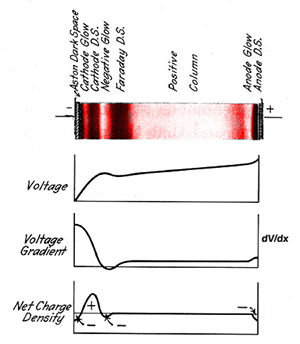
This is a diagram showing a discharge tube with all of the important features annotated above the tube. [D.S. = dark space]. Note that in the Sun’s huge environment, the only bright regions are very close to the Sun because the energy density is too low to excite a glow. Below the tube are graphs showing the variation of important variables along the tube length. The simple discharge tube demonstrates some of the complexity of electric discharges in near vacuum and surprisingly it holds the key to the mystery of spacecraft deceleration.
As Juergens argued, within our solar system the Sun bears all of the hallmarks of a small spherical anode in a galactic discharge. The planets occupy a vast region within the heliosphere, known in gas discharge theory as the positive column, which has a weak electric field centered on the Sun. Unlike the thin neon tube, the Sun occupies a vast sphere more than 16 billion miles across, so the positive column disappears and the current is carried throughout that volume by a low density of ionization. It requires only that the Sun’s electric field has sufficient strength to cause a drift of electrons toward the Sun, superimposed on their random thermal motion. In other words, it is immeasurably small. Notice that the net charge density in the positive column is zero. In other words, there are an equal number of negative and positive charges in interplanetary space. That is what spacecraft have generally found.
The regions of high electric field are close to the anode and cathode. In the Sun’s case, being the anode, it is in the corona, where electrons are accelerated toward the Sun, causing the apparent million-degree temperatures there, and the protons are accelerated away from the Sun–to form the solar “wind.” The continued acceleration of the positive particles in the solar wind beyond the orbits of Mercury and Venus is a natural consequence of the same weak electric field that slows down the negatively charged spacecraft. The cool photosphere beneath a “hot” corona is, for the first time, understandable if the Sun’s energy is delivered externally.
Of course, the Sun does not have an identifiable cathode in space like the metal cathode in the glow discharge tube. Instead, the plasma in space forms a bubble, known as a “virtual cathode.” Effectively it is the heliopause. In plasma terms, the heliopause is not a result of mechanical shock but is a Langmuir plasma sheath that forms between two plasmas of different charge densities and energies. In this case it forms the boundary between the Sun’s plasma and that of the galaxy. Such “bubbles” are seen at all scales, from the comas of comets to the ‘magnetospheres’ of planets and stars. To the plasma engineer they show that the central body is electrically charged relative to its surroundings.
After launch, a spacecraft accepts electrons from the surrounding space plasma until the craft’s voltage is sufficient to repel further electrons. Near Earth it is known that a spacecraft may attain a negative potential of several tens of thousands of volts relative to its surroundings. So, in interplanetary space, the spacecraft becomes a charged object moving in the Sun’s weak electric field. Being negatively charged, it will experience an infinitesimal “tug” toward the positively charged Sun. Of most significance is the fact that the voltage gradient, that is the electric field, throughout interplanetary space remains constant. In other words, the retarding force on the spacecraft will not diminish with distance from the Sun. This effect distinguishes the electrical model from all others because all known force laws diminish with distance. The effect is real and it will have a fundamental impact on cosmology and spacecraft navigation because…
Pioneer 10 has confirmed the electrical model of Stars!
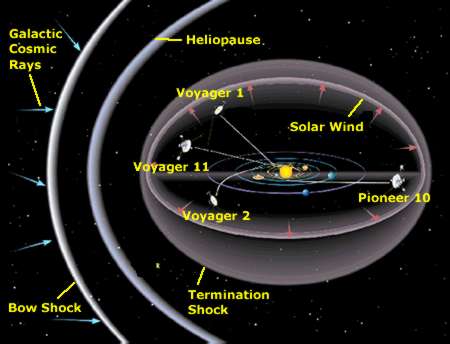
Pioneer 10 is now 7.4 billion miles from Earth, maybe 90 percent of the way to the heliopause. The electrical model of the solar system predicts that additional anomalies will be found if a distant spacecraft encounters the heliopause while still in contact with Earth. For the heliopause is the “cathode drop” region of the Sun’s electrical influence. It is a region of strong radial electric field, which will tend to decelerate the spacecraft more strongly. Almost the full difference between the Sun’s voltage and that of the local arm of the galaxy is present across the heliopause boundary. As a result, it is the region where so-called “anomalous” cosmic rays are generated by the strong field. It has nothing to do with a shock front and some poorly defined acceleration mechanism. Some measure of the driving electrical potential of the Sun may be gained from the study of “anomalous” cosmic rays. Also we can deduce the driving potential of other stars by the study of normal cosmic rays.
The implications of an electrical dimension to stars are profound. Obviously, if we do not understand our closest star, all speculation about more distant stars and their histories are misguided. Of course, it begs the question of the power source that maintains the galactic charge differentials to power stars. It is here that the electric star hypothesis merges seamlessly with plasma cosmology, which also had its origin in electrical engineering. Plasma cosmology, which is now recognized by the IEEE, is practically unknown amongst astronomers and astrophysicists. The latter have been content to ignore the warnings of Hannes Alfvén, the “father” of plasma physics and plasma cosmology, that their use of plasma theory is outdated and wrong.
For example, the spiral arms of a galaxy must carry the electric current that lights the stars. The force between parallel currents varies inversely with distance, instead of the much more rapid fall-off of gravity with the square of the distance. The result is that the longest-range force law in the universe governs galactic motions, and short-range repulsion maintains the integrity of the spiral arms. In comparison, by using the puny force of gravity astrophysicists must insist on the cranky notion that most of the mass in the universe is invisible and distributed in arbitrary fashion. Even so, they cannot explain the preferred spiral structure of galaxies.
As a leading member of The Spaceguard Foundation, Duncan Steel’s final comment about comets is self-serving. Those who publicize the threat of comet or asteroid impact with the Earth have a great deal to “unlearn” and learn anew about the electrical nature and origin of comets. What really happens when charged bodies are on a collision course? Who has ever seen a single bolt of lightning in an artist’s depiction of cosmic impact? Spaceguard argues that an impact could send us the way of the dinosaurs. But something far more dramatic than a puny impact killed the megafauna, simply because they could not function in Earth’s present gravity. Our scientific beliefs must change spectacularly once the electrical nature of the universe is recognized.
Images courtesy of NASA.
Solution of the mystery © Wal Thornhill 2002.